
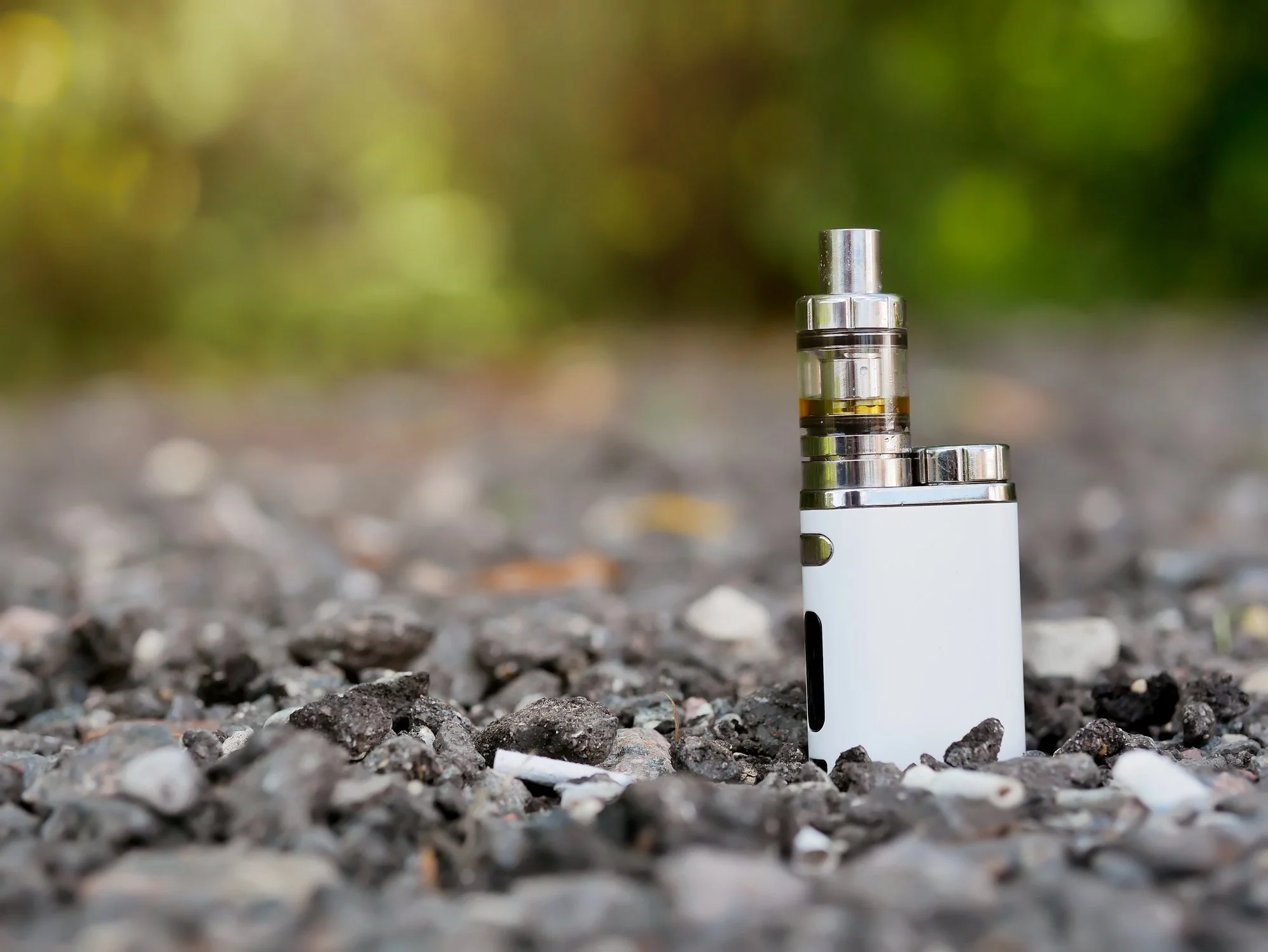
How a cartridge and its battery actually work, and what the number means
If your prescription came as a cartridge rather than dried flower, you will have been told you need a “510 battery” and possibly nothing else. It is one of those terms that everyone uses and nobody explains. This page explains what the number means, what each setting does, and what to check before you buy one.
The short version
What it is
A 510 battery is a power source and nothing more. The cartridge is the medicine.
Which is why you buy it separately. The cartridge is a prescription item; the battery is a piece of consumer electronics and anyone may sell it. Your pharmacy may not supply one at all.
510 is a size, not a brand. Turn your cartridge over. Sticking out of the base is a short metal post with a spiral groove cut round it — in effect, a tiny screw. It screws down into a matching hole in the top of the battery, and 510 describes that screw: 10 turns of the spiral, spaced 0.5mm apart.
The point of the number is compatibility. Whoever filled your cartridge and whoever built your battery are different companies, usually with no connection to each other. Both cut a 510 thread, so the two screw together regardless.
A matching thread does not guarantee a fit. The screw post is a standard size. The cartridge body above it is not, and a fat cartridge can jam on the rim of the battery even though the screw goes in perfectly. Measure your cartridge at its widest before you order.
That thread is also the electrical connection. Which is why a misbehaving battery usually needs wiping rather than replacing.
Choosing one
They come in different shapes. Most are pens — a slim tube that pockets easily — or palm-shaped, squat and wide to sit in a closed hand, which is easier if grip or fine movement is difficult.
Voltage is the only setting most batteries have. Turn it down for less vapour and a cooler, smoother draw. Turn it up for more vapour, warmer and harsher — and a cartridge that empties faster.
You do not set a voltage. You pick from a few fixed steps the maker chose, and some batteries have only one. So “three settings” tells you nothing on its own: one battery’s three are 2.4V, 2.8V and 3.2V, another’s are 2.8V, 3.2V and 3.6V.
A UK pharmacy says its cartridge manufacturers recommend not exceeding 3.2V. That is a ceiling rather than a target, and it is their cartridges — ask your own pharmacy about yours.
Both ends of a battery’s range matter, and both are fixed the day it is made. The lowest setting decides how gentle you can go; the highest decides whether you can avoid running hot at all. Look at the figures, not the price — some of the cheapest go lower than some of the dearest.
The same setting does not mean the same heat. The coil is in the cartridge, not the battery, so how hot a given voltage runs depends on which cartridge is on it — and the pharmacy chooses that, not you. A setting that suited the last one can feel different with the next.
A few batteries have a second setting: airflow. A collar you turn to widen or narrow the hole the air comes in through. Narrow for a warmer, denser draw; open for a cooler, lighter one that takes less effort to pull.
Two ways of switching it on, and it changes how much there is to learn. Inhale-activated means you draw on it and it heats, with nothing to remember. Button-operated means holding a button while you draw, and a sequence of clicks for everything else — but a button also means it only heats when you ask it to, which protects the cartridge if it is nearly empty.
Check whether it has preheat. A short warm-up that softens cold, thick oil before you draw on it. Not every battery has one, and the ones that are simplest to use are often the ones that do not — an inhale-activated battery with no button has no way to run a preheat.
Some hold more charge than others, which decides how often you plug it in rather than how the battery draws. The figures here run from 290 to 500 milliamp-hours, and they do not follow the price — one of the cheapest holds more than one of the dearest.
The rest is customisation. A screen instead of a coloured light, a window to see how much oil is left, a child-resistant lock, a magnet instead of a screw thread. None of it changes the draw, but one of them may be the thing that decides it for you.
Thick vapour is not a sign of strength. It mostly means a tighter, hotter setting — and an open setting was measured using more liquid per puff while producing vapour that looked thinner.
Using it
Cold oil is thick oil, and thick oil does not reach the coil properly. That is what preheat is for. If your battery has no preheat, take two or three short puffs before a full draw, especially on a new cartridge.
A burnt taste is often the setting rather than the cartridge. Turn it down before you do anything else. If it still tastes burnt at the lowest setting, the setting is not the cause.
If nothing happens at all, check the cartridge is screwed in firmly but not overtightened, and wipe the contacts.
If it leaks, heat is usually behind it. Keep it out of hot cars and off sunny windowsills, and store it upright.
The batteries themselves, with prices and voltages, are in cartridge batteries.
What a 510 battery is
A 510 battery is a power source. That is all it is.
Your cartridge — the part that came from the pharmacy, containing your medication — has a small heating element inside it. It has no power of its own. The battery screws onto the bottom, supplies electricity to that element, and the element warms the oil enough to turn it to vapour.
So the cartridge is the medicine. The battery is a rechargeable handle that supplies electricity to it.
Any vape is made up of several parts. A sealed disposable one has four: the tank of liquid, the heating element that warms it, the mouthpiece you draw through, and the battery that powers the whole thing. When it runs out you throw all four away.
A cartridge is the same object with the battery left out. You get three of the four parts and supply the fourth yourself — which is why the battery is a separate purchase, and why one battery will serve cartridge after cartridge.
That split is also why the battery is not a medical product. The cartridge is a prescription item. The battery is a piece of consumer electronics, and anyone may sell it.
What “510” means
It looks like a model number. It is actually a size.
Turn your cartridge over. A small metal post sticks out of the base, with a spiral ridge running round it. Now look at the top of the battery: a matching socket, with the same ridge cut on the inside. The post screws down into the socket, and that pair is the fitting. “510” is the specification both halves are cut to — which is why a cartridge from one company screws into a battery from another.
That spiral ridge is called a thread. It is what makes a screw screw in rather than push in. Think of a jam jar: the lid has a ridge running round the inside, the jar has a matching one round its neck, and turning the lid slides the two along each other and pulls it tight. Your cartridge attaches to your battery the same way, just very much smaller.
The digits are the measurements of that thread. The 10 is how many turns the spiral makes. The 5 is the gap between one turn and the next: half a millimetre. Every 510 fitting is cut to those same figures, which is what makes them interchangeable.
The standard covers the fitting, and nothing else. The cartridge body sitting above it — the part holding the oil — can be any size the manufacturer likes, and that is what sometimes stops a cartridge sitting properly in a battery. More on that below.
The thread is also the electricity
Think of an old screw-in lightbulb. You twist it into the socket, and that same thread does two jobs: it holds the bulb in, and it carries the electricity into it.
A 510 cartridge works exactly like that. The thread is not only holding the cartridge on — it is also how power gets from the battery to the heating coil, together with the small metal pin in the middle.
Two practical things follow.
Anything on those surfaces stops it working. It is the same as a torch that has gone dead and comes back to life once you rub the ends of the batteries clean. A smear of leaked oil does the same. So a battery misbehaving is very often a battery that needs wiping, not replacing. CCELL put it plainly:
“Good contact between the battery and the cartridge is critical for the normal operation of the device. Residue or dirt on the contact points can interfere with this connection, making the device blink.”
Finger-tight is enough. Over-tightening is a common reason a cartridge will not fire, and forcing it does not improve the contact — the same way winding a lightbulb harder does not make it brighter.
How to clean them differs by manufacturer and by device. That is set out in cleaning a 510 battery.
Why any cartridge fits any battery
510 is not a brand. Manufacturers with no connection to each other use it as a plain description, and that is why a cartridge from one will screw onto a battery from another.
With one qualification: the width of the cartridge.
The thread is standard. The body above it is not. If the cartridge is wider than the opening it sits in, it will catch on the edge and stop before it is all the way down — even though the thread itself screws in perfectly.
Some batteries publish a limit, but they do not measure the same thing:
CCELL Stylo — “Compatible with 510 carts up to 14mm in diameter.” That is the width.
G Pen Hydout — “Fits most 510 Cartridges up to 2G.” That is how much oil it holds, which is only a rough guide to its size.
Measure your cartridge at its widest before you order.
Same thread, different shapes
Because every 510 battery ends in the same connection, the rest of it can be almost any shape. What your pharmacy hands you is a cartridge; the thing you screw it onto is up to you. We stock only a couple of these shapes, but it is worth knowing the rest exist.
A handful of shapes have lasted:
Pen. A slim tube. The original, and still the most common. Pockets easily, looks like a pen. Some fire when you draw, some have a button.
E-pipe. Shaped like an old-fashioned pipe. A novelty rather than a technical difference — it works the same way, and comes in both draw-activated and button versions.
Keychain. Small and flat, made to hang on a keyring. The most discreet of the lot, and the easiest to keep to hand.
Box mod. A chunkier block, with more of the hardware open to adjustment than on a pen with three fixed settings.
Palm-shaped. Squat and wide, made to sit in a closed hand rather than between finger and thumb. A newer shape. A device you can hold in your whole hand is easier to manage if grip or fine movement is difficult.
What we stock is pens and palm-shaped ones. The M4, M4B Pro and Stylo are pens; the Palm SE, Palm Pro and Sandwave sit in the hand; the Hydout is between the two. We do not stock e-pipes, keychains or box mods.
None of these heats the oil differently. Shape decides how it carries and how it handles. Voltage decides the rest.
What voltage is, and what it does
A 510 battery has one job: push electricity through the small heating coil inside the cartridge.
Voltage is how hard it pushes. Not how much electricity — how hard. Closer to water pressure in a hose than to the amount of water in it. Push harder, and the coil gets hotter.
Heat is what turns the oil into vapour. This is the only setting most batteries have, so this is what changes when you turn it.
Turn it up and you get more vapour per draw, and a warmer, harsher one. You also get through the cartridge faster, because more oil is being vaporised each time. A cartridge that seems to be emptying quickly is often being run hot rather than being faulty or underfilled.
Turn it down and you get less vapour, and a cooler, smoother one. Far enough down and very little happens at all — a thin draw, or none. That can feel like a faulty cartridge when it is nothing of the sort, and it is worth ruling out before you decide a cartridge is dead. CCELL put the trade-off as flavour against volume, and describe their own three settings like this:
“2.8V for maximum flavor” “3.2V for a well-balanced experience” “3.6V for maximum vapor”
That is marketing language, but it matches what the setting does: lower for taste, higher for volume.
But you do not set a voltage. You pick from the ones the manufacturer already chose. A 510 battery is not a dial you can turn to any figure you like. It has a handful of fixed steps built into it — most have three, some have more — and a button or a switch cycles between them. Anything not on that short list is not available to you on that battery.
So which voltage is better? Here is what a pharmacy says about its own cartridges. Montu Pharmacy, who dispense UK prescriptions:
“Our oil cartridge manufacturers recommend not exceeding 3.2V”
That is a pharmacy quoting the people who fill its cartridges — a better source than a battery maker writing about its own hardware.
Two cautions. It is a ceiling, not a setting to aim for. And it is the figure for the cartridges Montu dispense, which may not be the ones you have. Ask your pharmacy, or look at the product details that came with your cartridge.
Either way, 3.2V is below the top setting on most of the batteries on this page.
So choosing a battery is choosing its voltages, and it is the one thing about it you cannot change afterwards. The cartridge you can swap. A charging cable you can replace.
If a draw tastes burnt or harsh, the first thing to try is turning the voltage down rather than buying a different cartridge. It costs nothing to check, and it is a setting as often as it is a fault.
Voltage is not a temperature, and your cartridge has an effect on it. The heating coil is inside the cartridge, not the battery. How much heat a given voltage actually produces depends on that coil — so the same battery, on the same setting, can run hotter in one cartridge than in another.
That matters more here than it would for anyone else, because you do not choose your cartridge. The pharmacy dispenses what the prescription says, and it can change between repeats. If a setting that suited the last one feels different with a new one, there is a reason for it, and it is likely not a fault in the battery.
Which is a reason to care what a battery’s settings are, at both ends. The cartridge is half of what decides how hot the coil runs, and it is the half the pharmacy chooses. The battery is the half you choose.
The lowest setting decides how gentle you can go. The highest decides whether you can avoid running hot at all — a battery fixed at one setting leaves you nowhere to move if a cartridge runs hot in it, and if that setting is at the top of the scale, there is no gentler option to try. Both ends are fixed the day the battery is made.
And it is not your dose. How much you take, and how often, is a matter for the clinic that prescribed it. Nothing here is advice about that.
What a higher setting does to the oil
Higher voltage does not only make more vapour. It also changes what comes off the oil.
Researchers ran a CCELL oil cartridge at three power levels and weighed what came out. More power delivered more cannabis per puff — up to a point, and then it stopped. The by-products carried on rising after it stopped. Their own conclusion was that a cartridge vaporiser “should ideally be operated at the lowest power setting possible.”
The figures, the limits of the study and what it does not show are in how hot does a 510 battery actually get.
“Three voltage settings” does not mean the same three
Most of the batteries we sell are described as having three voltage settings. They are not all the same three.
| Battery | Where it sits on price | Voltage |
|---|---|---|
| CCELL M4 | Cheapest | Fixed at 3.6V, no adjustment |
| CCELL Stylo | Low | 2.4V / 2.8V / 3.2V |
| CCELL M4B Pro | Low | 2.8V / 3.2V / 3.6V |
| CCELL Palm SE | Middle | 2.8V / 3.2V / 3.6V |
| CCELL Sandwave | Middle | 2.8V / 3.2V / 3.6V |
| G Pen Hydout | Higher | 2.4V / 2.8V / 3.2V / 3.6V / 3.8V, plus a 1.8V preheat |
| CCELL Palm Pro | Dearest | 2.8V / 3.2V / 3.6V |
Some have no choice at all. The M4 is fixed at 3.6V — the cheapest and the simplest, nothing to set, the same draw every time. But 3.6V is the top of the scale, so the simplest battery is also the one that puts you straight onto the hottest setting.
Most do not go below 2.8V. The exceptions here are the Stylo, near the bottom of the range on price, and the Hydout, near the top — both of which offer 2.4V. For the rest, 2.8V is as gentle as they get, which is where the Stylo’s middle setting sits. If you have been told to begin gently and work up, those are the two that can.
How it fires
This decides how complicated the battery is to use. Inhale-activated means you simply draw on it and it heats — there is nothing to learn. Button-operated means you hold a button down while you draw, and usually a sequence of clicks for everything else. The Stylo and Palm SE are inhale-activated. The Hydout is button-operated, and its manual sets out the whole sequence: five clicks on, three to change voltage, two for the 10-second preheat, hold the button while you draw, five clicks off, and it shuts itself off after two minutes.
One reason to prefer a button. CCELL warn about “dry burn”, which happens if you draw on a cartridge when there is no oil left over the heating element. In their words it “could ruin your cartridge’s flavor and burn the oil permanently even if it functions properly.” Their point about which battery you have:
“If you have a vape battery that is activated with a button, you are much safer from dry burn due to the fact that your cartridge will not be heating when you inhale without pressing on it.”
A draw-activated battery heats every time you pull on it, including the pull where you are checking whether anything is left.
What preheat is for
Preheat runs the coil gently for a fixed few seconds without you drawing on it.
The point is thick oil. Inside the cartridge is a wick — the absorbent material that carries oil from the tank onto the heating coil. Cold oil is thicker and does not travel into the wick easily, which is what makes a cartridge feel blocked or draw hard, and it is worse in a cold room or straight out of a coat pocket. Warming it first lets it flow.
A trade-off. CCELL note that on a battery activated by inhalation you may be “unable to preheat it with a button” — so the feature that makes a draw-activated battery easy to use can remove the remedy for a clogged cartridge.
Some get round it by being inhale-activated and having a button. The Stylo has a separate side button for preheat. The Palm Pro is listed as inhale activated with a 10-second preheat, reached by short-pressing its button twice.
The Palm SE is listed with a 15-second preheat and no button — 3WIN describe using it as “simply drop in a cartridge and use the mouthpiece to inhale and activate it.”
If your battery has no preheat, there is a way round it. Montu Pharmacy tell their own patients:
“Before your main draw, take 2-3 short ‘micro puffs’ first. This gently warms the oil so it flows properly into the heating chamber, rather than sitting thick and cold against the element.”
They say it matters most “the first time you use a new cartridge, or after the device has been unused for a while” — and they are blunt about the risk of not doing it. On a battery with no preheat, going “straight into a full, multi-second draw on a fresh or recently changed cartridge can risk burning out the ceramic heating element.”
How much this applies to you depends on what you were dispensed. Montu attribute the problem partly to their own product — “our premium oils, which are thicker and need a moment to soften.” Thicker oil needs more warming and oils differ between producers. Yours is whichever one your pharmacy dispenses — which makes them the people who know how thick it is, and the people to ask.
What airflow does
Some batteries have a collar you turn to widen or narrow the gap air comes in through. The Palm Pro is one example.
Voltage and airflow act on opposite halves of the same thing. Voltage sets how much heat goes into the coil. Airflow changes how much is carried away from it, and how much cool air the vapour is mixed with on the way out.
CCELL give three positions for their collar:
“FULLY OPEN - For less dense clouds and cooler vapors” “HALFWAY OPEN - Happy medium for flavor and clouds” “NARROWLY OPEN - For warm, dense, tasty clouds”
“Clouds” here means visible vapour. It is not a measure of quality, and it is an unreliable guide to strength.
Two studies have measured this, and between them they say three things.
Tighter airflow makes the coil hotter. With less air moving past it, the coil runs hotter.
Opening the airflow used more liquid per puff at the same power — so a thinner-looking vapour can mean more of the cartridge is being used up, not less.
Heat changes what comes off the liquid, and closing the collar does not cut those substances out of the draw. It changes which of them you get.
This is not like for like. Both studies used nicotine e-cigarettes, not cannabis cartridges. They ran on propylene glycol and glycerol — the liquid a nicotine vape uses — and a machine set the airflow, not a hand turning a collar. It would be reasonable to assume something similar happens with cannabis oil, but we have found nobody who has measured it, so we do not know.
There is more on that, and on what a cartridge contains in the first place, in how hot does a 510 battery actually get.
What it gives you in practice is a second thing to change when the draw is not right, and unlike voltage you feel it immediately. Narrow for a warmer, stronger-tasting draw of more concentrated vapour. Open for a cooler, lighter one that takes less effort to pull — which matters if drawing hard is uncomfortable for any reason. If you came to this from smoking, a tighter setting feels more normal.
Whether that is worth choosing a battery for is a separate question, and it is in which cartridge battery suits you.
The other differences
How much charge it holds. Measured in milliamp-hours, written mAh. A bigger number means more draws before you have to plug it in — it does not change how the battery performs, only how often you charge it. The M4 and M4B Pro are 290mAh, the Sandwave and Hydout 400mAh, and the Stylo, Palm SE and Palm Pro 500mAh.
There is a second reason to prefer a bigger cell. A rechargeable battery’s working life is counted in charge cycles rather than years, so one you charge half as often should last longer.
A screen. Tells you which voltage setting you are on and how much charge is left, rather than leaving you to work it out from a coloured light. The Stylo and Hydout have one. The Palm Pro shows charge on a three-bar LED. The M4 has neither.
A window to see the oil. Lets you check how much medication is left without taking the cartridge out, which matters when a repeat prescription has to be timed. The Stylo and Palm SE have one.
Hiding the cartridge. A cartridge sitting on top of a battery is recognisable for what it is; tucked into the body, it is far less so. Several do this: the Stylo has a deep slot, the Palm SE recesses it, and the Hydout has a magnetic cover over the mouthpiece. G Pen make a second claim for theirs — that the cover keeps the cartridge “protected from light,” which they say “helps preserve oil quality.” Light does degrade cannabis oil, so the reasoning holds. Whether a mouthpiece cover makes a measurable difference is not something they show.
A child-resistant lock. Stops the battery firing if something presses against it in a bag or a pocket, and stops it being switched on by accident. If there are children in the house this may matter more than any voltage setting. Only the M4B Pro has one — a five-click lock, and that is what the “Pro” in its name refers to.
Magnetic connection. The cartridge drops in and is held by a magnet instead of being screwed down, so there is no twisting — easier if grip or fine movement is difficult. The Sandwave and Palm Pro work this way. CCELL note on the Palm Pro that it “requires prior connection with magnetic cartridge nut” — a small ring is fitted to the cartridge, once, and it then drops straight in.
Charging. These charge over USB-C, the typical cable you will already have for a phone.
When something goes wrong
Burnt taste. Often voltage set too high — turn it down. But it may not be anything you are doing: CCELL explain that “if too little oil is let in, it may cause a burnt taste due to insufficient lubrication”, and they make cartridge inlet holes in five sizes — 1.2mm, 1.4mm, 1.6mm, 1.8mm and 2.0mm across — matched to how thick the oil is, larger for thicker oils and smaller to stop runnier ones rushing in. If the hole is the wrong size for the oil, that was settled when the cartridge was filled, long before you were handed it. If it still tastes burnt at the lowest setting, the setting is not the cause — and that is worth knowing before you spend any longer adjusting it. More in when your cartridge isn’t behaving.
No vapour, battery clearly working. The cartridge may be cold or the oil settled. A preheat usually resolves it.
Nothing at all. Check the cartridge is screwed in firmly but not overtightened, and look at the contacts. Forcing it can damage the seal, and it makes the cartridge harder to get off again. Montu Pharmacy give the same advice to their patients: “Don’t overtighten the cartridge when attaching it, this can damage the seal and make it harder to remove later.”
Leaking. The same inlet-hole mechanism at the other extreme — CCELL: “If too much oil is let in, the overflow may cause suction leakage.” Heat makes it likelier. See where to keep your cartridge.
What we stock
We stock CCELL batteries and the G Pen Hydout.
What CCELL say about CCELL. On their own About page they describe themselves as “one of the world’s largest vaporizer suppliers”, say they revolutionised the industry by introducing “the world’s first ceramic heating component”, and put a number on it in their brand history: “440 million cartridges shipped to date” as at 2021. Elsewhere they call themselves “the first company to perfect ceramic heating technology in vaporizers.”
What G Pen say about G Pen. The Hydout is made by Grenco Science and sold as G Pen. Their About page runs to two sentences: that G Pen “Engineers The Most Advanced, User-Friendly Portable Vaporizers”, and that it “was the first to market a tank system specifically designed for essential fluids and personal aromatherapy regimens.”
Why we stock the Hydout. It is the only battery here with a setting at each end of the range — 2.4V at the bottom, 3.8V at the top, and three steps in between. Every other one on this page either starts at 2.8V, stops at 3.6V, or both. It also comes with a good instruction manual.
Questions about the kit? Email us at hello@asprescribed.co.uk. We can help with anything on this page — what fits what, and what a given battery does.
Where to read it for yourself
Every quotation on this page is linked below, with a note on what each source is. All of it is free to read except where noted.
The makers
CCELL Stylo · Palm Pro · Sandwave — the specifications in the table, the three voltage descriptions, the three airflow positions, the 14mm cartridge width limit, and the Palm Pro’s magnetic cartridge nut footnote
CCELL, why a vape pen blinks ten times (20 September 2024) — the contacts quotation and the “dry cloth” advice. Their blog, not a manual
CCELL, why vape pens clog (12 July 2022) — the dry burn warning and the button-versus-draw point. “Unable to preheat it with a button” appears there as one of four conditions under a fix for a clog, not as a general statement
CCELL, what an inlet hole is (25 December 2018) — the burnt-taste and leaking explanation and the five hole sizes
About CCELL — the company’s own claims about itself
About G Pen — Grenco Science, who make the Hydout. Quoted above
3WIN Corp — authorised CCELL distributor, and the source for the M4, M4B Pro and Palm SE, which CCELL do not list themselves. The Palm SE instructions sit inside collapsed FAQ answers
G Pen Hydout manual (PDF) — the manufacturer’s instruction manual. The button sequence, the two-minute auto shut-off and the cleaning instruction. Where this and the product page differ, follow the manual
S10 Labs, A History Of The 510 Thread Cartridge (December 2021) — the explanation that the 10 in “510” is the number of turns of the thread. A hardware maker writing about its own category
The thread
BAER Tools, tap set MF 7 x 0,5 — 510 thread — a German toolmaker’s listing for the tap that cuts this thread. Where the 7mm and 0,5mm come from. A tool supplier, not a standards body
The pharmacy
Montu Pharmacy, CCELL M4 and ACTIVE Sprout — a UK dispensing pharmacy. Source of the “not exceeding 3.2V” figure, the micro-puffs advice and the overtightening warning. Read September 2026
The research
Every study quoted on this page is listed, with what it measured and what it cannot tell you, in how hot does a 510 battery actually get.
Further reading
Versed Vaper, guide to vape airflow — a vaping guide, not a study
Manufacturers’ pages read September 2026. They revise them without notice.
Written September 2026
General information, not medical advice
As Prescribed sells equipment. We are not a pharmacy, a clinic or a prescriber, and nothing here is medical advice. This article is general information written for people who already hold a prescription — it is not tailored to you and takes no account of your condition, your other medicines or your circumstances.
Please read things for yourself: follow the manufacturer's instructions supplied with your device and the patient information supplied with your medication in preference to anything we have written. For anything about your medication, your dose or your condition, speak to your prescribing clinician or your dispensing pharmacy.
We set out what we know so you can weigh it up, check it against your own sources, and decide for yourself what suits you.
